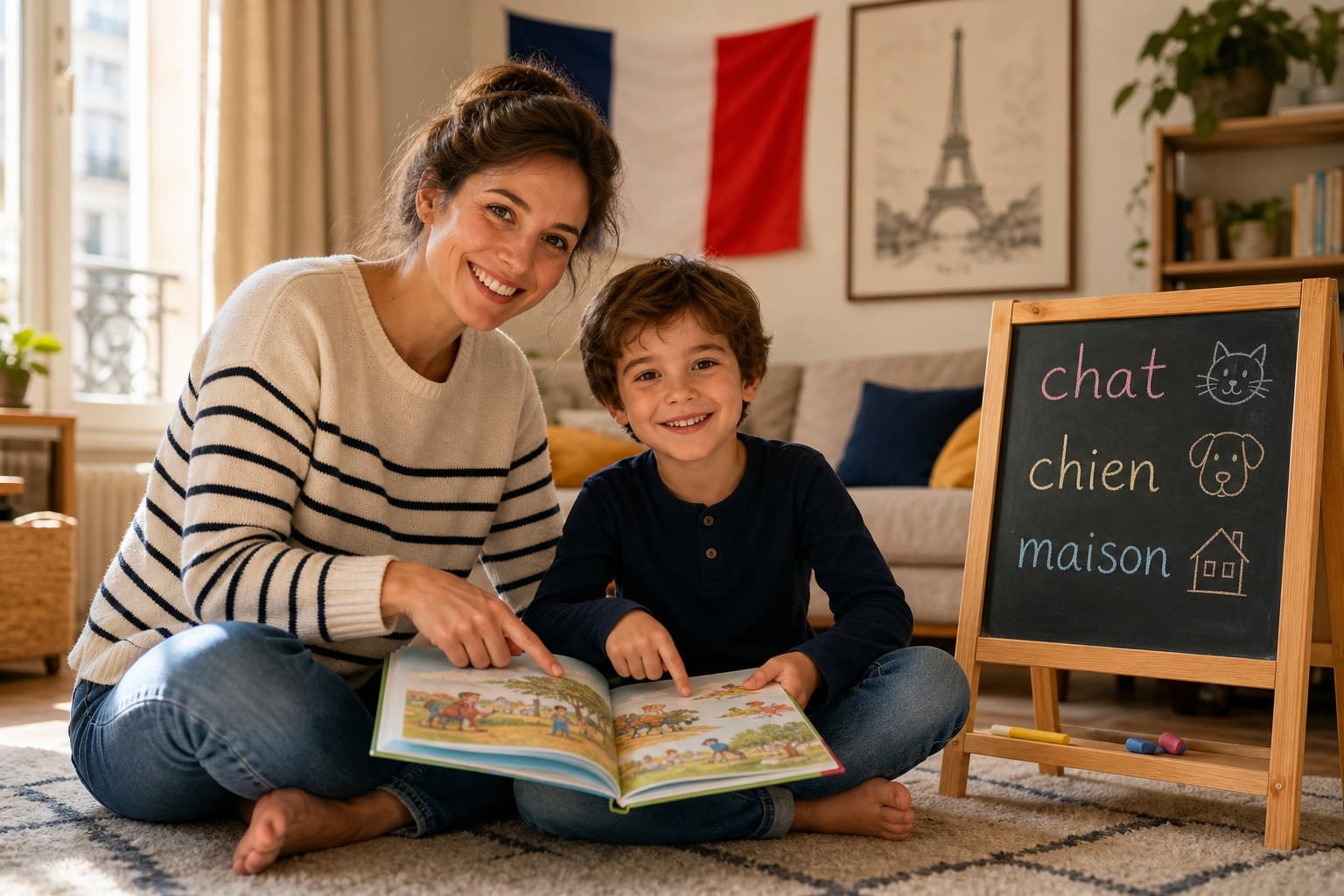
French for Kids: Free and Fun Ways to Start Learning at Home
9 min read
You don't need a French nanny, an immersion school, or a stack of expensive workbooks to give your child a real head start in French. What actually works at home is short, playful, repeated exposure: a song on repeat in the car, a cartoon in French instead of English on a Saturday morning, a picture book read together at bedtime. Kids don't need to understand every word to absorb the sounds, the rhythm, and eventually the meaning — that's exactly how they learned their first language too.
This guide breaks down what actually works by age, a list of free songs, shows, and books to start with today, a simple 15-minute daily routine, and the mistakes well-meaning parents make that quietly kill a kid's motivation. If you're building your own French from scratch alongside your child, pair this with our guide on French vocabulary for everyday life and learning French with music — both work just as well for a curious 8-year-old as they do for you.

- Why kids absorb a new language differently than adults — and why that matters for method.
- What to do at each age: toddlers, early readers, and tweens need very different approaches.
- Free songs, shows, and books to start with this week — no subscription required.
- A simple 15-minute daily routine that fits into a normal family schedule.
- The most common mistakes parents make that turn French into a chore instead of a habit.
Why Kids Pick Up French Differently Than Adults
Adults tend to reach for grammar rules first — conjugation tables, gender lists, verb charts. Kids do the opposite, and it works better for them: they absorb sounds and patterns first, meaning comes later, and the rules get backfilled naturally once enough real examples pile up in their ears.
Two things make this possible. First, young children are far less self-conscious about making mistakes out loud — they'll happily mangle a French word in a song without a flicker of embarrassment, which means more repetition and more speaking practice than most adults ever attempt. Second, children's hearing for unfamiliar sounds is generally more flexible before puberty, so nasal vowels and the French r that trip up adult learners tend to land more naturally when a child hears them constantly and early.
The practical takeaway: skip the grammar lecture. Favor songs, shows, and books that a child actually wants to hear again, and let the patterns sink in through repetition rather than explanation.
French for Kids by Age: What Actually Works at Each Stage
The right method changes a lot between a 3-year-old and a 10-year-old. Match the approach to the stage instead of using one method for every age.
Toddlers and preschoolers (ages 2–5): sound and rhythm first
At this age, the goal isn't vocabulary lists — it's making French sounds a normal, comforting part of daily life. Nursery rhymes on repeat, a few French words woven into daily routines (bonjour, au revoir, merci, animal names), and short French cartoons work well because toddlers already rewatch the same episode ten times without complaint.
Don't quiz a toddler on vocabulary. Just let the sounds play in the background of normal life — bath time, car rides, breakfast — and let curiosity do the rest.
- 5–10 minutes of French songs during a daily routine (car ride, bath, breakfast).
- One short French cartoon episode instead of an English one, a few times a week.
- Point-and-name games with picture books — no pressure to repeat the word back.
Early readers (ages 6–8): stories, questions, and simple words
Once a child is reading in their first language, they can start connecting spoken French to written French. This is the sweet spot for bilingual picture books, subtitled shows, and simple call-and-response games ("Comment tu dis chien en français ?").
Kids at this age also enjoy being the one who "knows something the parent doesn't" — let them teach you a word they picked up from a show. It flips the dynamic and makes the language feel like their discovery, not a lesson imposed on them.
- Bilingual or simple French picture books read together, out loud.
- French cartoons with French audio (subtitles in their first language if needed).
- A running "word of the day" the child gets to introduce to the family.
Tweens (ages 9–12): structure, short goals, and real practice
Tweens can handle actual structure without it feeling like school, as long as sessions stay short and have a visible sense of progress — a streak, a level, a small goal. This is also the age where light, game-like conjugation practice starts to pay off, because they're already forming full sentences and benefit from making the verb forms automatic rather than guessed.
Keep any formal practice under 10–15 minutes a day. Longer sessions at this age tend to backfire and build resentment rather than fluency.
- Short daily practice sessions (10–15 minutes) rather than long weekend cramming.
- French shows and podcasts aimed at native kids their age, not textbook dialogues.
- A simple, visible way to track progress — most tweens respond well to streaks and small wins.
Free Songs, Shows, and Books to Start With
You don't need a subscription to get started. These are the categories of free resources that consistently work well for French-learning kids — search for the exact titles on YouTube or your library app, since availability varies by country.
| Type | What to look for | Best age |
|---|---|---|
| Nursery rhymes (comptines) | Classics like Frère Jacques, Alouette, Une souris verte, Savez-vous planter les choux — widely available free on YouTube. | 2–6 |
| French kids' cartoons | Shows made for French toddlers and preschoolers, such as T'choupi et ses amis and Trotro — simple sentences, slow pacing, lots of repetition. | 2–7 |
| Dubbed favorites | A show your child already loves and knows by heart, watched in its French dub — familiarity fills in the gaps in comprehension. | 4–10 |
| Picture books | French board books built around repetition, like the T'choupi and Petit Ours Brun series, or a French edition of a book you already own in English. | 2–8 |
| Library apps and public library shelves | Many public libraries stock French children's books and offer free digital lending apps — worth checking before buying anything. | 3–10 |
A Simple 15-Minute Daily French Routine for Kids
Consistency beats intensity with kids. A short daily habit that survives a busy week will always outperform an ambitious plan that collapses after day three.
Keep it the same time each day
Attaching French to an existing routine — right after breakfast, right before bed — removes the need for willpower. The habit runs on autopilot once it's tied to something that already happens every day.
| Minutes | Activity | Why it works |
|---|---|---|
| 5 | Sing or replay a French song from the day before | Repetition builds recall without effort. |
| 5 | Read a page or two of a French picture book, or watch a short clip | Connects sound to meaning through context. |
| 5 | Play with the words — point-and-name, a mini quiz, or (for tweens) a quick app session | Turns passive listening into active use. |
Mistakes Parents Make (and How to Avoid Them)
These four habits are the most common reasons kids lose interest in French at home.
Correcting every mistake out loud
Starting with grammar and conjugation tables
Treating French as homework instead of play
Giving up after a quiet week
When Kids Are Ready for Active Conjugation Practice
Somewhere around age 8–9, once a child reads comfortably and is already stringing full sentences together, passive exposure alone starts to plateau. This is the point where a little active practice — actually producing and checking verb forms, not just recognizing them — starts to pay off.
Keep it light: 10 minutes, game-like, with a clear sense of progress. A structured app like Croissant Verbs works well here because sessions are short and self-paced, so a tween can practice présent, passé composé, or futur proche on their own or alongside a parent who's brushing up too. It's a natural next step after the exposure-first years, not a replacement for them — keep the songs and shows going alongside it.
Frequently asked questions
- What age should I start teaching my child French?
- There is no wrong age to start — even babies benefit from hearing French songs and sounds. Most families find that starting around age 2–3 with songs and simple words, then adding books and shows around age 5–6, gives the smoothest ramp-up without overwhelming the child.
- Do I need to speak French myself to teach my child?
- No. Many parents successfully expose their kids to French using songs, shows, and books they play or read together, learning right alongside their child. You don't need to be fluent to press play on a French cartoon or sing along to a nursery rhyme.
- How much screen time in French is healthy for a kid learning the language?
- Follow your family's normal screen-time limits — the goal is simply to swap some existing screen time for French content, not to add extra hours. A French cartoon in place of an English one a few times a week is enough to make a real difference over months.
- Are free resources enough, or does my child need a paid program?
- Free songs, shows, library books, and casual practice are genuinely enough for years of solid progress, especially before age 8. A paid program or app becomes more useful later, once a child is ready for structured, active practice rather than passive exposure.
- When should my child start learning conjugation and grammar rules?
- Around age 8–9 is a reasonable point to introduce light, structured practice, once a child reads comfortably and is already forming full sentences on their own. Before that, exposure through songs, shows, and books does more for long-term fluency than any grammar chart.
There's no secret formula to raising a French-speaking kid — just consistent, low-pressure exposure that respects where they are developmentally. Match the method to the age, keep sessions short, and let curiosity do most of the work.
- Toddlers: sounds and songs on repeat, no pressure to perform.
- Early readers: stories, simple words, and a bit of reading connection.
- Tweens: short structured practice alongside continued shows and books.
- Every age: 10–15 minutes a day beats an occasional long session.
Pick one song or one book this week and start the routine today. In a few months, you'll notice your child humming along or naming things around the house in French without even being asked.