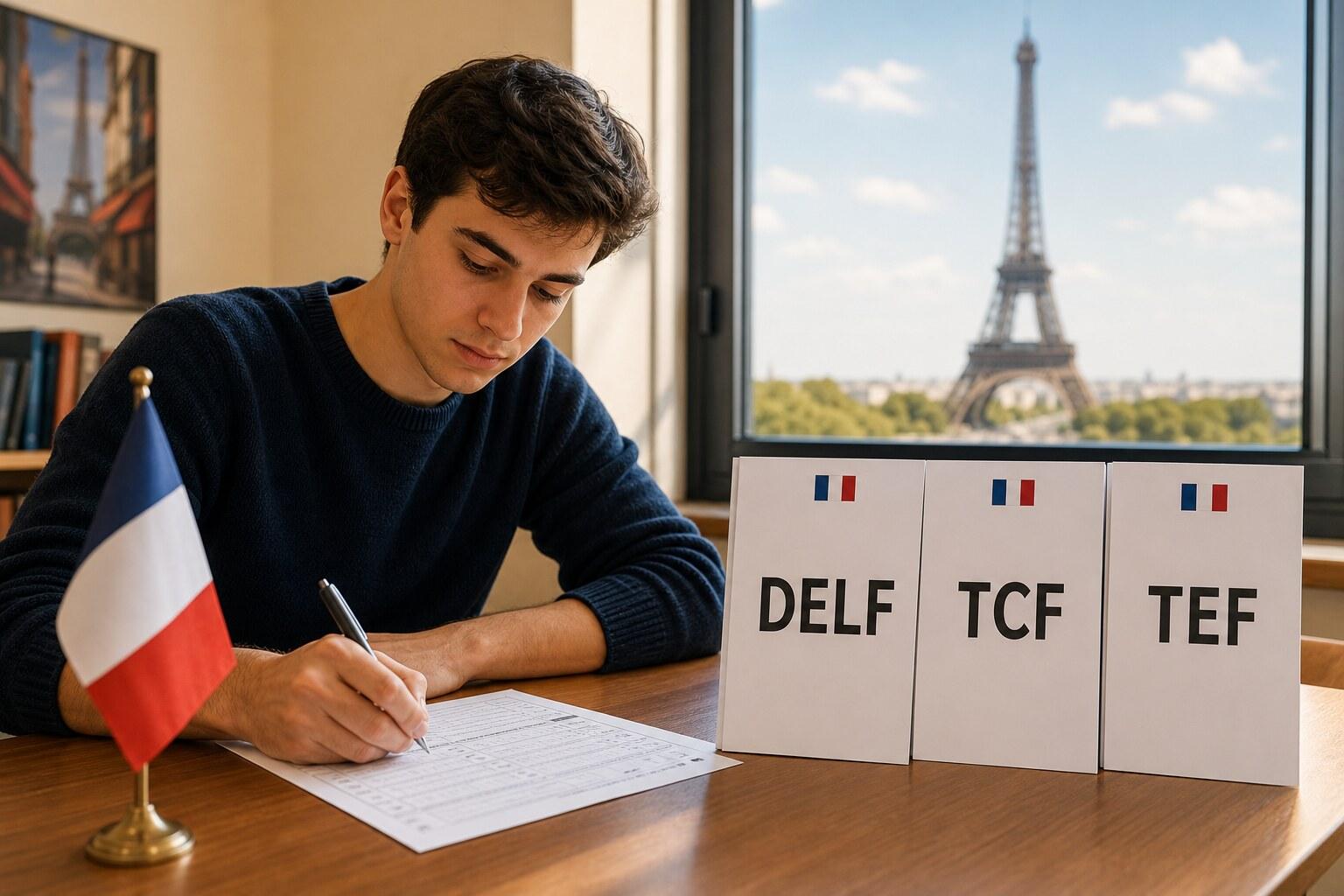
DELF vs TCF vs TEF: Which French Exam Should You Take?
10 min read
Sooner or later, most serious French learners run into the same wall: a visa officer, a university, or a naturalization form that does not ask "are you fluent?" — it asks for a certificate, with a specific exam name and a specific score. That is when DELF, TCF, and TEF stop being acronyms and start being a real decision with real deadlines attached.
All three test the same four skills — reading, listening, writing, speaking — and all three map onto the same CEFR scale (A1 to C2). But they are built by different organizations, scored completely differently, valid for different lengths of time, and accepted by different institutions. Picking the wrong one can cost you months: a diploma that proves exactly the level you need, submitted to an administration that does not accept it. This guide breaks down what each exam actually is, how they compare side by side, and how to pick the right one for your specific goal — citizenship, immigration to Canada, university admission, or just a personal benchmark.

- What DELF and DALF are, who administers them, and why the diploma never expires.
- What the TCF measures, how its 100–699 scale works, and why it is tied to a 2-year validity window.
- What the TEF measures, its different versions (TEF Canada, TEF Naturalisation, TEFAQ), and its scoring scale.
- A side-by-side comparison table of format, cost, validity, and typical use case for all three.
- A simple decision guide matched to your goal: citizenship, Canada/Quebec immigration, university in France, or a personal milestone.
- How to prepare efficiently for the speaking and writing sections that trip up most candidates.
DELF and DALF: France's Official Diplomas
The DELF (Diplôme d'Études en Langue Française) and its advanced counterpart the DALF (Diplôme Approfondi de Langue Française) are issued by France Éducation international, a French government agency, on behalf of the Ministry of Education. They are the most widely recognized French-language diplomas in the world, accepted by universities, employers, and immigration authorities in dozens of countries.
DELF covers levels A1 through B2; DALF picks up where it leaves off, covering C1 and C2. Each level is a separate, standalone diploma — you register for the exact level you want (say, B1) rather than sitting one giant test that assigns you a grade.
How DELF/DALF is scored
Each of the four skills (reading, listening, writing, speaking) is marked out of 25 points, for a total out of 100. You pass if you score 50/100 or higher overall, with no skill below 5/25 — so you cannot pass by acing three sections and bombing the fourth.
Validity: the diploma never expires
A DELF or DALF diploma is valid for life — once you hold a B2, for example, you never need to retake it. This is the single biggest practical advantage over the TCF and TEF, which both expire after two years. The trade-off is that a DELF result only tells an administration "this person passed B2 at some point," not how fresh that French currently is — which is exactly why some administrations prefer the TCF or TEF instead.
TCF: The Test de Connaissance du Français
The TCF is also administered by France Éducation international, but it works completely differently from the DELF. Instead of registering for one fixed level, you sit one test covering all four skills, and your result places you somewhere on the full A1–C2 scale — the exam adapts to show your actual level rather than confirming a level you chose in advance.
How the TCF is scored
Each skill is scored on a scale from 100 to 699, and that numeric score maps to a CEFR level (for example, roughly 400–499 corresponds to B2). Because the scale is continuous, the TCF is useful when an institution needs a precise, numeric threshold rather than a pass/fail diploma.
Validity and versions
TCF results are valid for two years from the test date. There are several versions tailored to different purposes — TCF Tout Public (general purpose), TCF Canada (for Canadian immigration, including Express Entry), and TCF pour l'accès à la nationalité française (for French citizenship applications) — and they are not always interchangeable, so always confirm which version the receiving institution requires.
TEF: The Test d'Évaluation de Français
The TEF is administered by the Paris Île-de-France Chamber of Commerce and Industry (CCI Paris Île-de-France), not by France Éducation international. Like the TCF, it is a single adaptive-scope test that places you on the CEFR scale rather than certifying one level you picked in advance.
How the TEF is scored
Each skill is scored on its own scale (commonly up to 900 points for the sections used in Canadian immigration files), and the combined profile maps to a CEFR level per skill. As with the TCF, the appeal is a precise numeric score that immigration points-systems can plug directly into a formula.
Validity and versions
TEF results are also valid for two years. The main versions are TEF Canada (Express Entry and other federal programs), TEFAQ (Quebec-specific immigration), and TEF Naturalisation (French citizenship) — each draws on a slightly different combination of the four skills, so the version matters as much as the overall score.
DELF vs TCF vs TEF at a Glance
Here is the same information side by side. Use it as a quick reference once you know roughly why you need a certificate — the decision guide in the next section narrows it down further.
| Criteria | DELF / DALF | TCF | TEF |
|---|---|---|---|
| Administered by | France Éducation international | France Éducation international | CCI Paris Île-de-France |
| Format | One fixed level per sitting (A1–C2) | One adaptive test, result placed on A1–C2 | One adaptive-scope test, result placed on A1–C2 |
| Scoring | Pass/fail, /25 per skill, /100 total | Numeric, 100–699 per skill | Numeric, up to ~900 per skill depending on version |
| Validity | Lifetime — never expires | 2 years | 2 years |
| Typical use case | University admission, personal/professional benchmark | Canada immigration, French citizenship | Canada/Quebec immigration, French citizenship |
| Cost (approximate) | €40–€220 depending on level | €80–€150 depending on version | €100–€200 depending on version |
Which Exam Should You Take?
Match the exam to the institution asking for it — not the other way around. Here is how the most common goals usually sort out.
French citizenship (naturalization)
French naturalization requires proof of at least B1 level. Both the TCF pour l'accès à la nationalité française and the TEF Naturalisation are explicitly built for this and are widely accepted by préfectures. A DELF B1 diploma also works and has the advantage of never expiring — useful if you expect a gap between passing the exam and filing your file.
Immigration to Canada or Quebec
Canadian federal programs (including Express Entry) and Quebec's selection process accept TCF Canada and TEF Canada (or TEFAQ for Quebec specifically) — not the DELF. These feed a numeric score directly into points-based immigration formulas, so a precise, recent result matters more than a pass/fail diploma here.
University admission in France
Most French universities ask for DELF B2 as a baseline, with some selective or graduate programs requiring DALF C1. The TCF is sometimes accepted as an alternative — always check the specific program's requirements through Campus France or the university's admissions page before registering.
Personal milestone or no fixed deadline
If nothing external is forcing your hand, DELF/DALF is usually the better pick: you choose the exact level you are targeting, it never expires, and it is the most internationally recognized of the three for general-purpose use (employers, personal records, other European administrations).
How to Prepare for Any of These Exams
The four skills tested are identical across DELF, TCF, and TEF, so most preparation transfers directly between them — only the exact format of the questions changes.
- Target the right level, not the highest one. Overshooting (registering for B2 when you test at B1) wastes money and often results in failure instead of a lower, still-useful diploma.
- Drill speaking and writing specifically — these are the sections where candidates lose the most points, usually to weak verb conjugation and tense agreement rather than vocabulary gaps.
- Use official past papers. France Éducation international and the CCI Paris Île-de-France both publish sample tests for DELF/TCF and TEF respectively — practicing the exact question formats matters more than generic study.
- Time your mock exams. All three exams are strictly timed, and running out of time on the writing section is one of the most common avoidable mistakes.
- Keep your conjugation sharp in the weeks before the exam. A short daily routine — like the 10-minute conjugation practice — pays off disproportionately in the speaking and writing scores.
Common Mistakes When Choosing a French Exam
These five mix-ups account for most of the wasted registrations and rejected files.
- Taking the DELF for a Canadian immigration file. Canadian programs want TCF Canada or TEF Canada/TEFAQ — a DELF diploma, however high the level, will not satisfy the requirement.
- Registering for the wrong TCF or TEF version. TCF Canada and TCF pour la nationalité française are not interchangeable, and the same is true for TEF Canada vs TEF Naturalisation — always confirm the exact version the receiving institution asks for.
- Letting a TCF or TEF result expire. Both expire after two years; submitting an expired score is treated the same as not having one.
- Assuming a DELF diploma needs renewing. It does not — if an institution asks you to "retake" an old DELF, double-check whether they actually need a TCF/TEF instead, since that confusion is common.
- Underestimating the speaking section. It is live and unscripted in all three exams — reading comprehension skills do not transfer to it, and it needs dedicated, spoken practice.
Frequently asked questions
- Is DELF or TCF easier?
- Neither is inherently easier — they test the same CEFR levels with comparable difficulty. The DELF lets you choose your level in advance and only asks you to clear that one bar, while the TCF places you wherever you land on the full scale in a single sitting. Some candidates find the DELF less stressful because they know exactly what they are aiming for.
- Which exam is accepted for Canada immigration: DELF, TCF, or TEF?
- Canadian federal programs (Express Entry) and Quebec immigration accept TCF Canada and TEF Canada (or TEFAQ for Quebec). The DELF is not accepted for these immigration files, even though it tests the same underlying skills.
- Does the DELF diploma expire?
- No. DELF and DALF diplomas are valid for life once you pass. The TCF and TEF, by contrast, are only valid for two years from the test date, since they are designed to certify your current level rather than a level you once reached.
- Can I take the TCF or TEF without choosing a level in advance?
- Yes — that is the core difference from the DELF. You sit one test covering all four skills, and your numeric score is translated into a CEFR level afterward, so you do not need to predict your level before registering.
- Which exam should I take for French university admission?
- Most French universities require DELF B2 at minimum, with some graduate or selective programs asking for DALF C1. Always verify the exact requirement through the specific program or Campus France, since some accept the TCF as an alternative.
- How much do DELF, TCF, and TEF cost?
- Roughly €40–€220 for DELF/DALF depending on the level, €80–€150 for the TCF depending on the version, and €100–€200 for the TEF depending on the version. Prices vary by test center and country, so always confirm the current fee with your local exam center.
DELF, TCF, and TEF test the same four skills on the same CEFR scale — the real decision is not about difficulty, it is about matching the exam to whoever is asking for it.
- DELF/DALF: choose your level, pass/fail scoring, valid for life — best for university admission and general-purpose use.
- TCF: one adaptive test, numeric score (100–699), valid 2 years — required for Canada immigration and French citizenship.
- TEF: one adaptive-scope test, numeric score, valid 2 years — the main alternative to the TCF for Canada/Quebec immigration and citizenship.
- Always check which exact version (TCF Canada vs TCF nationalité, TEF Canada vs TEFAQ vs TEF Naturalisation) the receiving institution requires before registering.
Whichever exam you choose, the speaking and writing sections reward solid, automatic verb conjugation more than any other single skill — build that foundation with the free Croissant Verbs app in the weeks before test day.