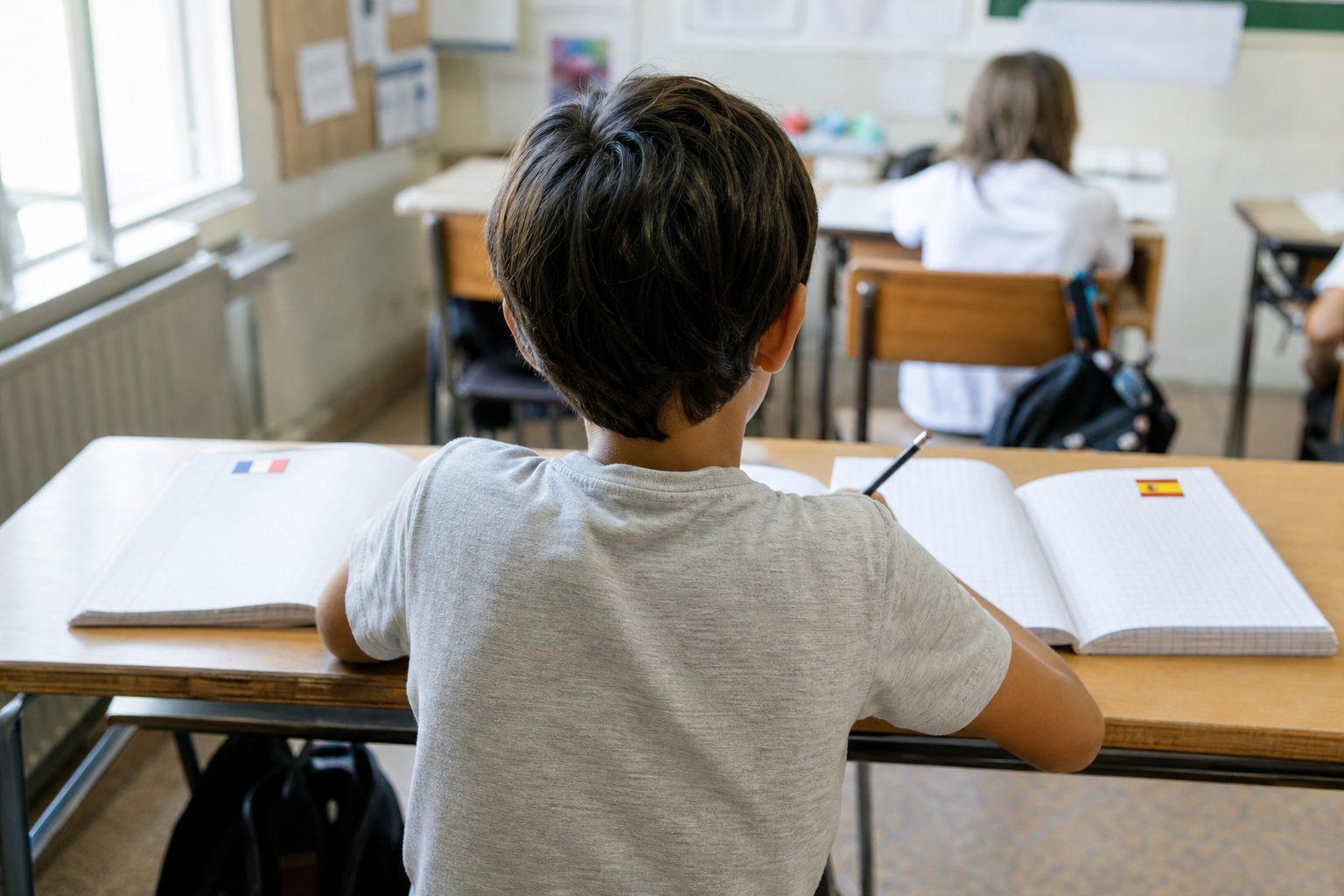
French or Spanish at School: Which Should You Choose?
4 min read
French or Spanish? There is no language that is right for everyone. Spanish usually sounds easier at the start. French asks more of your ears and your spelling, but for an Italian speaker its grammar and vocabulary are very close.
This guide is written first for families and pupils in Italy, who pick a second EU language when they enrol in middle school (“scuola secondaria di primo grado”). Most of the comparison also works if you are choosing elsewhere. (Italian version of this page: see the language selector.)

- How the second-language choice works in Italian middle schools.
- How many Italian pupils learn French, Spanish and German.
- Where French or Spanish is easier for an Italian speaker.
- Which school certificates exist for each language.
- Five questions to ask before ticking the box.
How the choice works in Italian middle schools
The national timetable (DPR 89/2009, article 5) gives middle school pupils 3 hours of English and 2 hours of a second EU language each week. The same article lets families ask for “inglese potenziato” (extra English), which can use those 2 hours, only if the school's staffing allows it and there are no surplus second-language teachers.
Enrolment is online, on the Ministry's “Piattaforma Unica”. For 2026/27 the window ran from 13 January to 14 February 2026. As of 26 November 2026 we found no official note with the 2027/28 dates, so check the Ministry website and your school. Last checked: November 2026.
What Italian pupils study today
French is still the most common second language in Italian lower secondary education. These are Eurostat figures for 2024 (table “educ_uoe_lang01”). Spanish has been growing: it was 25.6% in 2021. A popular choice is not automatically the right one for you. Last checked: November 2026.
| Language | Share of pupils in Italy (2024) |
|---|---|
| English | 99.5% |
| French | 57.6% |
| Spanish | 27.2% |
| German | 9.4% |
Which is easier if you speak Italian?
Both are Romance languages, so you do not start from zero with either. A word-list comparison usually attributed to Ethnologue gives Italian a lexical similarity of about 0.89 with French and 0.82 with Spanish. It counts related words, not how hard a language is to learn, so read it as a hint only.
- Pronunciation: Spanish has an advantage. Its sounds are close to Italian and words are mostly read as written.
- Spelling: Spanish again. French has many silent letters: “tu parles” and “ils parlent” sound the same as “je parle”.
- Vocabulary: French has many near twins of Italian words: “la fenêtre” (la finestra), “manger” (mangiare), “la table” (la tavola).
- False friends: both have traps. In French, “la gare” is the station, not a race (Italian “gara”). In Spanish, “burro” is a donkey, while Italian “burro” is butter.
Verbs: the same sentence in three languages
Verbs are where the difference shows. Like Italian, French builds the past with two auxiliaries, “avoir” and “être”. Spanish uses only “haber”. On the other hand, Spanish lets you drop the subject pronoun, as Italian does, and French does not.
| Italian | French | Spanish |
|---|---|---|
| mangio (I eat) | je mange | como |
| ho mangiato (I have eaten) | j'ai mangé | he comido |
| sono andato (I have gone) | je suis allé | he ido |
| mangiavo (I used to eat) | je mangeais | comía |
School certificates
Both languages have official exams designed for young learners. For French, the DELF scolaire / junior (France Éducation international) offers four independent diplomas, A1, A2, B1 and B2. For Spanish, the Instituto Cervantes offers the DELE A1 para escolares and the DELE A2/B1 para escolares. Ask your school whether it prepares pupils for either one, and check dates and fees with an official exam centre. No app or course can guarantee a pass. Last checked: November 2026.
Five questions to ask before you choose
- Which languages does this school really offer, and how does it assign them if one is oversubscribed?
- Which language will you use? Think of relatives, holidays, friends, or a border you often cross.
- Which one do you want to hear? Motivation matters over three years. Listen to a few songs or videos in both.
- What about high school? Check whether the schools you are considering continue the same language.
- Who can help at home? A parent or older sibling who speaks one of them is a real advantage.
Try a little French before deciding
Read these aloud, then listen to a native recording. If the sounds make you curious rather than annoyed, that is a good sign. You can see every form of être and avoir on their verb pages, and try the short quiz at the bottom of this page.
| French | English | Italian |
|---|---|---|
| Je suis italien. | I am Italian. | Sono italiano. |
| J'ai douze ans. | I am twelve. | Ho dodici anni. |
| Nous parlons français. | We speak French. | Parliamo francese. |
| Tu vas à l'école ? | Are you going to school? | Vai a scuola? |
Test yourself in 5 questions
Pick the right verb form. The tense to use is shown in every question.
Question 1 of 5
Tense: présent
Il ____ (pouvoir).
Frequently asked questions
- Is French or Spanish easier for an Italian speaker?
- Spanish is usually easier to pronounce and spell at the beginning. French shares a great deal of vocabulary and verb structure with Italian, but its pronunciation and spelling take more work.
- Can my child take extra English instead of a second language?
- Italian rules allow families to request inglese potenziato using the two second-language hours, but only if the school staffing allows it. Ask the school before enrolling.
- When do we choose the second language in Italy?
- The preference is normally given when enrolling in the first year of middle school. For 2026/27 enrolment ran from 13 January to 14 February 2026. Check the official dates for the following year.
Choose Spanish if an easier start and its sounds attract you. Choose French if you like its sound, have a reason to use it, or want a grammar that mirrors Italian closely. Either is a good choice if you practise a little and often.
- Check what your school offers before comparing languages.
- Pick the language you are curious about.
- Plan short, regular practice: lessons, listening, reading and verb drills.