French Negation Guide: How to Say "Not" (and More) in French
7 min read
Knowing how to say something in French is only half the battle—you also need to know how to say it does not happen, has never happened, or will happen no more. French negation is built around a two-part structure that wraps around the verb, and once you understand the pattern it applies consistently across all tenses.
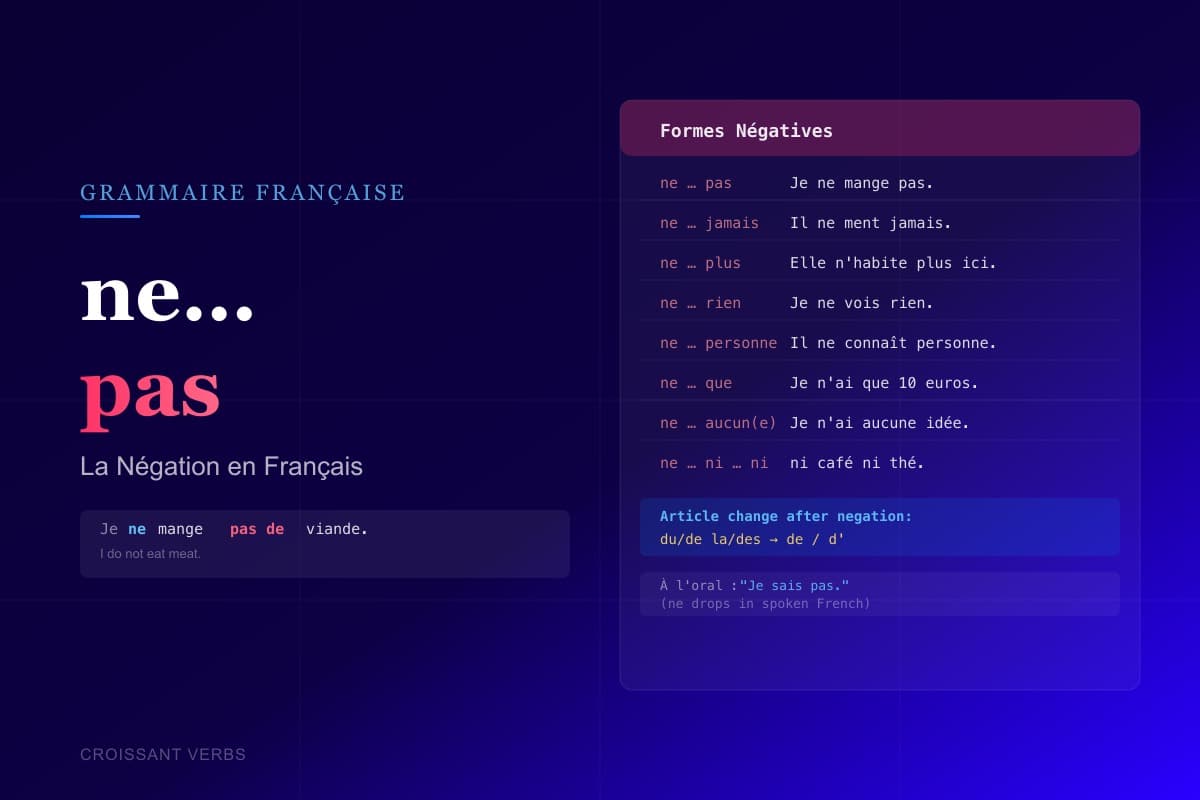
The core structure—ne … pas—is the foundation. But French has a rich family of negative expressions: *ne … jamais* (never), *ne … plus* (no longer), *ne … rien* (nothing), *ne … personne* (nobody), *ne … que* (only), and more. Each slot follows the same placement logic.
This guide covers every negative form you need, how placement shifts in compound tenses, how articles change after negation, and when spoken French drops the *ne* entirely.

- The two-part ne…pas structure and where each part goes around the verb.
- All major negative expressions: jamais, plus, rien, personne, que, and more.
- How to place negation correctly in compound tenses (passé composé, etc.).
- Why indefinite and partitive articles change to de/d' after negation.
- When and how spoken French drops the ne.
- The most common negation mistakes to avoid.
The Foundation: ne … pas
The basic French negative structure uses two parts that wrap around the conjugated verb:
> ne + [conjugated verb] + pas
The *ne* goes immediately before the verb (or before any pronoun that precedes the verb), and *pas* goes immediately after.
- *Je parle français.* → *Je ne parle pas français.* — I do not speak French. - *Elle aime le café.* → *Elle n'aime pas le café.* — She does not like coffee. - *Nous allons au marché.* → *Nous n'allons pas au marché.* — We are not going to the market.
With reflexive verbs or object pronouns, *ne* still goes before everything that precedes the verb:
- *Je me lève.* → *Je ne me lève pas.* — I do not get up.
All the Negative Forms
The *pas* slot can be replaced by other negative words to express more specific meanings. The *ne* stays in place; only the second element changes.
Personne and rien as subjects
*Rien* and *personne* can also appear at the beginning of a sentence as the subject. In that case, *ne* still follows immediately before the verb, but the negative word moves to subject position:
- *Rien ne me surprend.* — Nothing surprises me. - *Personne n'est venu.* — Nobody came.
Ne … que: restriction, not negation
*Ne … que* means only and is a restriction, not a true negation — the action still happens. *Que* is placed directly before the element being restricted:
- *Je ne bois que de l'eau.* — I drink only water. - *Il ne travaille que le matin.* — He works only in the morning.
Because *ne … que* is a restriction and not negation, articles after it do not change to *de* (see the next section).
| Expression | Meaning | Example |
|---|---|---|
| ne … pas | not | Je ne mange pas de viande. |
| ne … jamais | never | Il ne ment jamais. |
| ne … plus | no longer / not anymore | Elle n'habite plus ici. |
| ne … rien | nothing / not anything | Je ne vois rien. |
| ne … personne | nobody / not anyone | Il ne connaît personne. |
| ne … que | only (restriction) | Je n'ai que dix euros. |
| ne … aucun(e) | not any / no (+ noun) | Je n'ai aucune idée. |
| ne … nulle part | nowhere | Je ne vais nulle part. |
| ne … ni … ni | neither … nor | Il n'aime ni le café ni le thé. |

Practice French conjugation for free in the Croissant Verbs app
Quizzes and spaced repetition for every tense, for free on your phone—plus short grammar guides on our Learn hub.


Negation in Compound Tenses
In compound tenses such as the passé composé, the two negative parts wrap around the auxiliary verb (*avoir* or *être*), not around the whole compound:
> ne + [auxiliary] + pas + [past participle]
- *J'ai mangé.* → *Je n'ai pas mangé.* — I did not eat. - *Elle est partie.* → *Elle n'est pas partie.* — She did not leave. - *Nous avons fini.* → *Nous n'avons pas fini.* — We did not finish.
Exception: personne and nulle part
*Personne* and *nulle part* are placed after the past participle in compound tenses, not between the auxiliary and participle:
- *Je n'ai vu personne.* — I saw nobody. (personne after mangé) - *Elle n'est allée nulle part.* — She went nowhere.
| Tense type | Affirmative | Negative |
|---|---|---|
| Present (simple) | il mange | il ne mange pas |
| Imperfect (simple) | il mangeait | il ne mangeait pas |
| Future (simple) | il mangera | il ne mangera pas |
| Passé composé | il a mangé | il n'a pas mangé |
| Plus-que-parfait | il avait mangé | il n'avait pas mangé |
| Futur antérieur | il aura mangé | il n'aura pas mangé |
Articles After Negation: du/de la/des → de
After most negative expressions, indefinite articles (*un, une, des*) and partitive articles (*du, de la, de l'*) change to de (or d' before a vowel). This is one of the most important — and most forgotten — negation rules.
- *Je mange du pain.* → *Je ne mange pas de pain.* — I do not eat bread. - *Il boit de la bière.* → *Il ne boit pas de bière.* — He does not drink beer. - *Nous avons des amis.* → *Nous n'avons pas d'amis.* — We have no friends. - *Je veux un café.* → *Je ne veux pas de café.* — I do not want a coffee.
Definite articles do not change
Definite articles (*le, la, les*) do not change after negation — they stay as *le, la, les*. The rule only applies to indefinite and partitive articles.
- *J'aime le fromage.* → *Je n'aime pas le fromage.* — I do not like cheese. (*le* stays) - *Elle connaît les règles.* → *Elle ne connaît pas les règles.* — She does not know the rules.
| Article (affirmative) | After negation | Example (negative) |
|---|---|---|
| un / une | de / d' | Je n'ai pas d'argent. |
| des | de / d' | Il ne mange pas de légumes. |
| du | de / d' | Elle ne boit pas de café. |
| de la | de / d' | Je ne veux pas de soupe. |
| de l' | de / d' | Il ne prend pas d'eau. |
Spoken French: Dropping the ne
In informal spoken French, the *ne* is routinely dropped. You will hear this constantly in real conversations, films, podcasts, and everyday exchanges. The *pas* (or other second element) alone carries the negative meaning.
- *Je ne sais pas.* → *Je sais pas.* — I don't know. - *C'est pas vrai !* — That's not true! - *Il vient plus.* — He's not coming anymore.
This is widespread in everyday speech at all levels of society. In formal writing, both *ne* and *pas* are always required.
When to keep the ne
Always keep *ne* in: formal writing, official documents, literature, academic work, and professional emails. In speech, dropping it is natural and will not make you sound incorrect — in fact, keeping *ne* in very casual conversation can sometimes sound overly formal.
Common Negation Mistakes to Avoid
A handful of predictable errors appear again and again. Knowing them in advance locks in correct habits faster.
- Forgetting to change the article: *Je ne mange pas du pain* is wrong in standard French. → *Je ne mange pas de pain.*
- Placing the two parts incorrectly: Both *ne* and *pas* must flank the conjugated verb. *Je ne pas parle* is wrong. → *Je ne parle pas.*
- Putting personne/nulle part before the participle: In compound tenses, these go after the participle: *Je n'ai vu personne* (not *Je n'ai personne vu*).
- Confusing ne…que with real negation: *ne…que* means *only* — the verb still happens. Articles do not change to *de* after *que*.
- Dropping ne in writing: Always write both *ne* and *pas* in formal contexts, even when you would drop *ne* in speech.
Frequently asked questions
- Can I always drop the ne in spoken French?
- Yes, in informal conversation dropping the *ne* is completely natural and extremely common. You will sound unnatural if you always keep it in casual speech. Keep both *ne* and *pas* in formal writing, exams, and professional contexts.
- What is the difference between ne…plus and ne…jamais?
- *Ne…plus* means *no longer* or *not anymore* — something that used to happen but has stopped: *Elle ne travaille plus ici* (she no longer works here). *Ne…jamais* means *never* — something that has never happened or will never happen: *Il ne ment jamais* (he never lies).
- Why does "du" change to "de" after negation?
- After most negative expressions, French requires the partitive or indefinite article to become plain *de*. The logic is that negation cancels out the idea of "some" or "a". Only definite articles (*le, la, les*) stay the same after negation because they refer to specific, already-identified nouns.
- Where does "pas" go in the passé composé?
- In compound tenses, *pas* goes between the auxiliary and the past participle: *je n'ai pas mangé*, *elle n'est pas partie*. The exception is *personne* and *nulle part*, which follow the past participle: *je n'ai vu personne*.
- How do I say "I don't like anything" vs "I like nothing"?
- Both translate to *ne…rien*: *Je n'aime rien.* For emphasis, *rien* can move to subject position: *Rien ne me plaît* (Nothing pleases me). The meaning is essentially the same; the subject-position form adds slight emphasis.
French negation is one of those topics that rewards early mastery: once the two-part structure clicks, it applies to every tense and every negative form you will ever need.
- Start with ne…pas across present, passé composé, and imparfait until placement is automatic.
- Learn the article change rule (du/de la/des → de) separately — it trips up learners at every level.
- Memorise the exception list: *personne* and *nulle part* go after the past participle in compound tenses.
- Expand to ne…jamais, ne…plus, ne…rien, ne…personne one at a time.
- Listen for the dropped ne in spoken French — it will sharpen your listening comprehension immediately.
Practice by taking sentences you already know and negating them. The more you produce negation actively, the faster it becomes automatic.